

How Water-Resistant Is Your Watch, Really?
"100 metres" does not mean you can dive to a hundred metres. It is a laboratory value, measured in static conditions, on a new watch, in still water. Understanding the gap between that number and real life is what keeps a watch dry for years.
What the Rating Actually Measures
A water resistance rating is obtained by placing the watch under static pressure equivalent to a given depth. Nobody swims statically. The moment you move your arm through water, you generate dynamic pressure that briefly exceeds the static rating: diving into a pool, water skiing, or simply swimming a fast crawl.
That is why the industry reads ratings conservatively:
- 3 ATM / 30 m: splashes and rain. Not swimming.
- 5 ATM / 50 m: handwashing, rain, a brief swim. Not diving in.
- 10 ATM / 100 m: swimming and snorkelling with confidence.
- 20 ATM / 200 m: serious water sports.
Ratings differ from one Chrono Mod model to another. The exact figure for the watch you are looking at is listed in its specifications on the product page. Always check there rather than assuming every model is identical.
The Choice That Changes Everything: Your Case Back
This is the part specific to a configurable watch, and the one people miss.
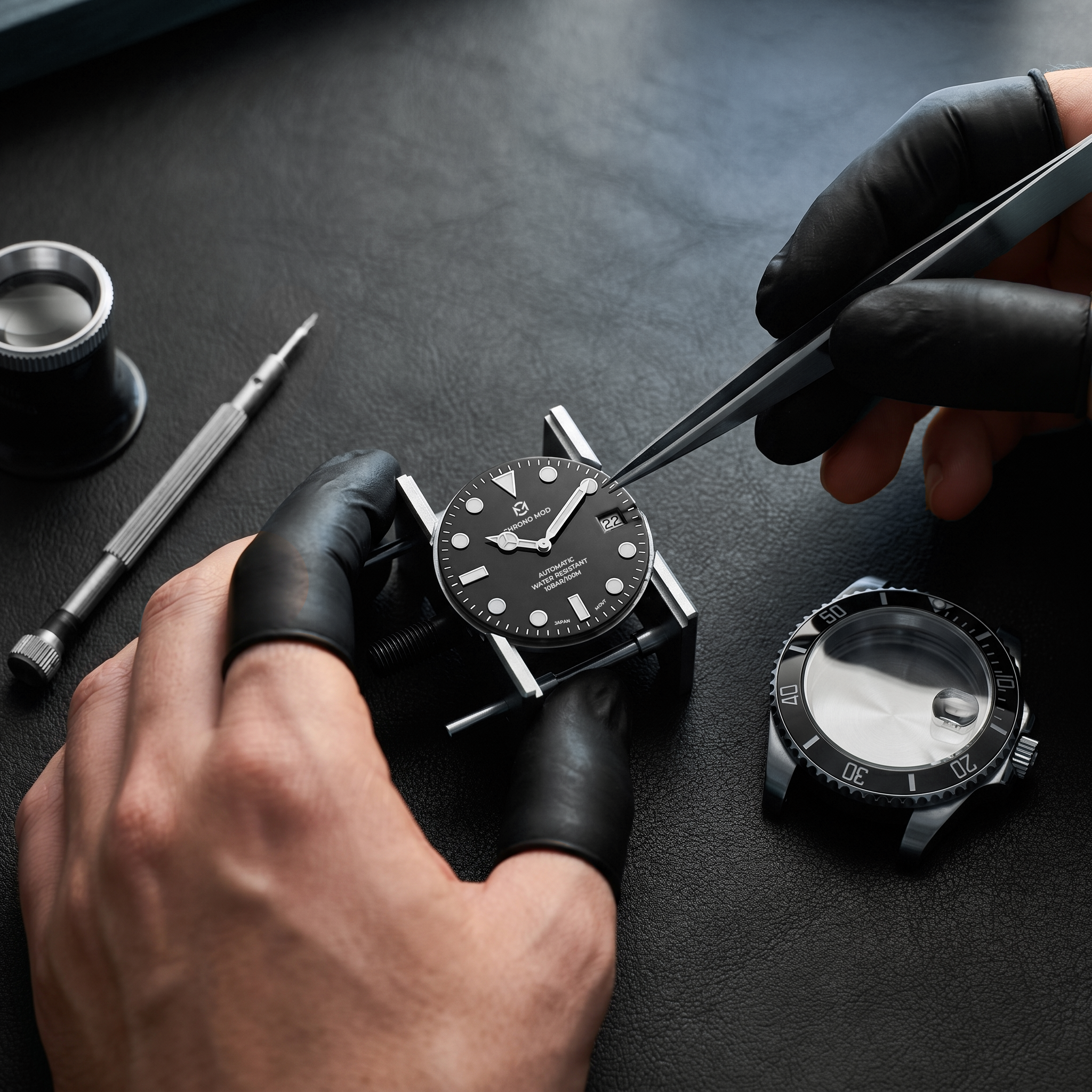
A solid steel case back screws down against a rubber gasket and gives you the full water resistance the model is rated for. A sapphire exhibition case back (the one that lets you watch the rotor spin) is a different construction, and it does not offer the same sealing.
So the rule is simple. If you plan to swim with your watch, configure it with the solid steel case back. If you want to see the movement working, choose the exhibition back and treat the watch as splash-resistant only. Both are legitimate choices. What is not legitimate is choosing the glass back and then taking it into the sea.
Note that water damage caused by wearing an exhibition case back in water is not covered by the warranty: not because we are strict, but because it is a choice, not a defect.
The Crown Is the Other Half of the Story
On models with a screw-down crown, the seal only exists when the crown is fully screwed in. A crown left unscrewed after setting the time is the single most common cause of water getting inside a watch. Before any contact with water, turn the crown clockwise until it stops. It takes one second.
Never operate the crown while the watch is wet or submerged.
What Actually Kills Water Resistance
- Heat. Hot showers, saunas and hammams are worse than swimming. Heat expands the metal and degrades the rubber gaskets, and steam penetrates where liquid water would not.
- Soap and shampoo. Surfactants reduce water surface tension and attack gaskets over time.
- Age. Gaskets are rubber. They harden and shrink after a few years, whatever you do.
- Impact. A knock that deforms the case back or crystal seat breaks the seal invisibly.
Keeping It Watertight
If you regularly wear your watch in water, have the seals tested and replaced every two to three years by a watchmaker. It is a quick, inexpensive job and it is the difference between a watch that lasts decades and one that fogs up one summer.
After swimming in the sea, rinse the watch under fresh water and dry it. Salt crystallises in the gaps between the case back and the case, and around the crown, and it is abrasive.
If Condensation Appears Under the Crystal
Stop wearing the watch and contact a watchmaker, or write to us. Moisture inside the case will corrode the movement within days. This is one of the rare situations where acting fast genuinely changes the outcome.