

Article: Which Case Size Actually Fits Your Wrist
Which Case Size Actually Fits Your Wrist
Buying a watch online means you cannot try it on. Colour is easy to judge from a photo. Size is not. It is the one decision our after-sales inbox sees people regret: never the dial they chose, never the bracelet, almost always the diameter.
Here is how to get it right in two minutes, without guessing.
Step 1 – Measure Your Wrist Properly
Take a soft tape measure and wrap it around your wrist, just past the wrist bone, where you actually wear a watch. Snug, not tight. Note the number in centimetres.
No tape measure? Use a strip of paper or a piece of string, mark where it overlaps, then lay it flat against a ruler. It takes thirty seconds and it is the only measurement that matters.
Step 2 – Match It to a Case Diameter
These ranges are guidelines, not rules. They describe what most people find balanced.
- Under 15 cm: 34 to 36 mm. A larger case will overhang the wrist and sit awkwardly.
- 15 to 17 cm: 36 to 40 mm. The most flexible range: dress models and sport models both work.
- 17 to 19 cm: 39 to 42 mm. Diver and GMT proportions look natural here.
- Above 19 cm: 40 to 42 mm and up. Smaller cases will read as delicate rather than discreet.
On several of our models the case size is one of the options you configure, so you are not locked into a single diameter. The exact sizes available are shown in the configurator, model by model.
Step 3 – Check Lug-to-Lug, Not Just Diameter
This is the number almost everyone ignores, and it matters more than diameter for comfort. Lug-to-lug is the distance from the tip of the top lug to the tip of the bottom lug: in other words, the real footprint of the watch on your wrist.
A 40 mm case with short, curved lugs can wear smaller and more comfortably than a 38 mm case with long, flat lugs. If the lugs extend past the flat part of your wrist, the watch will rock and the bracelet will never sit right, whatever the diameter says.
The practical rule: the lug-to-lug should stay within the flat top surface of your wrist. Measure that flat area once and you will never buy the wrong watch again.
Step 4 – Decide How Much Presence You Want
Two watches of identical diameter can look completely different on the wrist:
- Thin bezel, light dial: the dial opening looks wider, the watch reads larger and dressier.
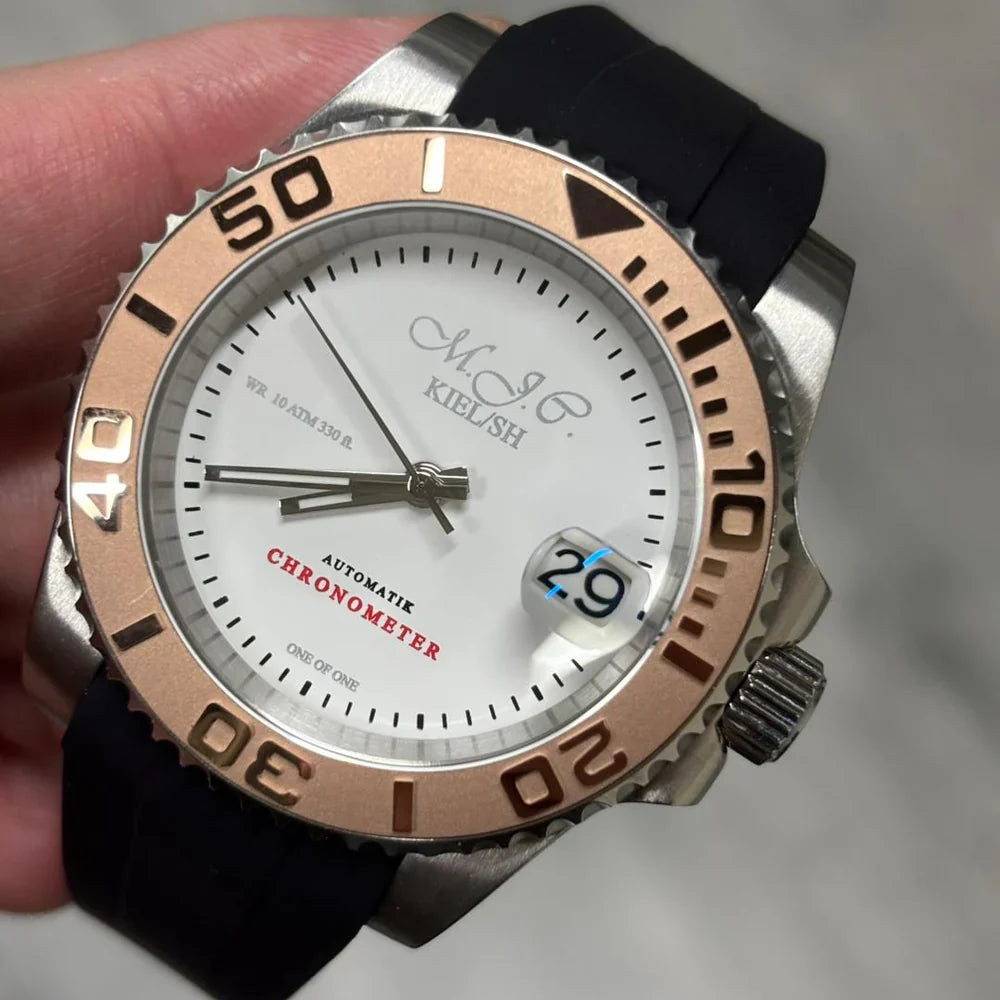
- Thick or coloured bezel, dark dial: the watch reads smaller but heavier in character. Diver models sit here.
- Integrated bracelet: the case and bracelet form one line, which visually extends the watch across the wrist.
So the question is not only "what fits" but "how much do I want it noticed". Both answers are valid. They just are not the same watch.
A Note on Thickness
An automatic movement needs room: a rotor, a mainspring barrel, a gear train. Any automatic watch will be thicker than a quartz one of the same diameter. If you wear tailored shirts and want the watch to slide under a cuff, choose a smaller diameter with a flat crystal rather than a diver case with a domed one.
Still Hesitating Between Two Sizes?
Take the smaller one. A watch that is slightly small reads as deliberate and classic. A watch that is slightly large reads as borrowed. And if you are genuinely stuck between two configurations, write to us before you order. We answer in a few hours, seven days a week, and we would rather spend five minutes on your wrist measurement than process a return.